Bitcoin ETFs vs Native DeFi: Custody and Yield (2026)
Compare Bitcoin ETFs vs native DeFi in 2026 and understand the real tradeoff between custody, yield, access and control before choosing your approach.
Bitcoin, DeFi, and the Great Custody Divide of 2026.
- As we stand in March 2026, the digital asset landscape has reached a level of structural maturity that seemed like a distant dream only a few years ago. Bitcoin is no longer just a volatile ticker symbol for speculators: it has become a core treasury asset for corporations and a foundational layer for decentralized finance.
- However, this maturity has created a profound split in how investors choose to hold their wealth. On one side, we have the massive wall of institutional capital flowing into Spot Bitcoin ETFs. On the other, we have the "sovereign individuals" utilizing Native DeFi and Self Custody 2.0 to turn their Bitcoin into productive capital.
Choosing between these two paths is the most significant decision a crypto investor faces in 2026.
The Institutional Wrapper: Why ETFs Dominate Traditional Portfolios
- For the majority of institutional allocators and traditional retail investors, the Spot Bitcoin ETF has become the primary gateway to the asset class. By March 2026, the initial novelty of the 2024 approvals has faded, replaced by a robust infrastructure of regulated products from giants like BlackRock, Fidelity, and Grayscale. These products offer a level of convenience that self custody simply cannot match for the average person.
- The primary appeal lies in tax efficiency and regulatory peace of mind. In the United States, the implementation of the GENIUS Act has solidified the rules for custodial crypto assets, while in Europe, the MiCA (Markets in Crypto Assets) framework is now in full enforcement.
- An investor in 2026 can hold Bitcoin within their retirement account, such as a 401k or a SIPP, benefiting from immediate tax advantages. For a pension fund managing billions, the ability to gain Bitcoin exposure without managing private keys or worrying about "wrench attacks" is a non negotiable requirement.
The Sovereign Movement: Native DeFi and Self Custody 2.0
- While ETFs capture the headlines of the financial press, a quieter revolution has taken place in the world of native self custody. The "Self Custody 2.0" movement of 2026 has solved the primary friction points that once plagued decentralized storage. Through the widespread adoption of Account Abstraction (ERC 4337) and Multi Party Computation (MPC), managing a private wallet no longer requires the nerve wracking responsibility of guarding a 24 word seed phrase on a piece of metal.
- Native DeFi users in 2026 use "Smart Wallets" that allow for social recovery, daily spending limits, and two factor authentication directly on the blockchain. This has empowered a new class of "high agency" investors who live by the mantra of "not your keys, not your coins." For these users, the primary risk of an ETF is not just the management fee, but the "black box" nature of custodial risk. They remember the lessons of the early 2020s and prefer the transparency of the ledger over the promises of a brokerage statement.
Yield Generation: Dead Assets vs Productive Capital
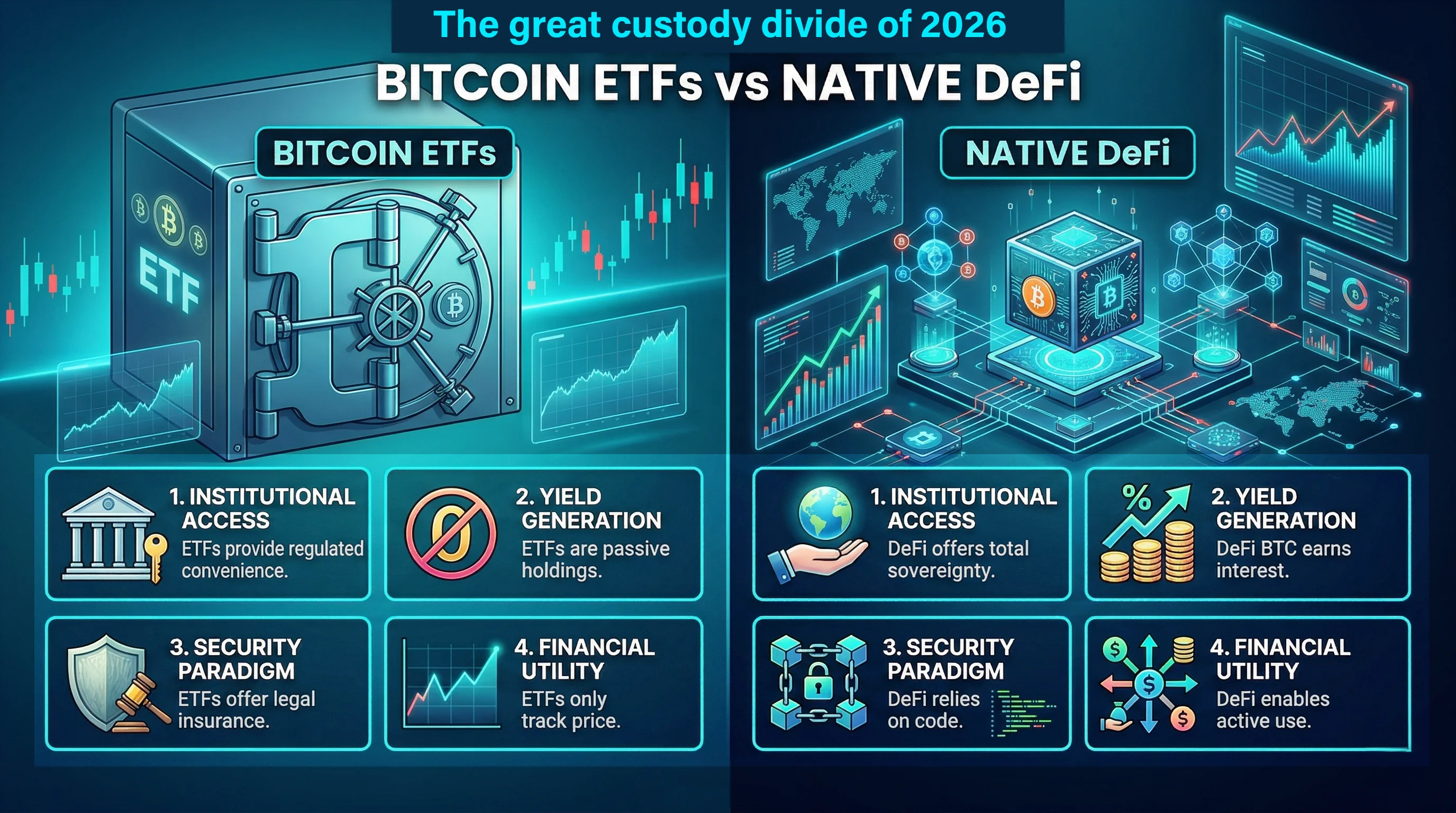
- The most significant differentiator in 2026 is the concept of yield. A Bitcoin ETF is essentially a "dead asset." It tracks the price of BTC, but the underlying coins sit idle in a cold storage vault. For an investor seeking only price appreciation, this is sufficient. However, for those who view Bitcoin as a capital asset, the ETF model is increasingly seen as inefficient.
- Native DeFi has unlocked the era of "Programmable Bitcoin." Through the massive growth of Bitcoin Layer 2 solutions such as Stacks, Babylon, and Merlin Chain, holders can now earn a yield on their native BTC. For example, a user in 2026 can stake their BTC via a protocol like Babylon to provide security to other PoS networks, earning a native yield of 3 to 5 percent without ever giving up custody of their assets. This transformational shift has made native BTC a "productive asset," similar to real estate or dividend paying stocks, whereas an ETF remains a purely speculative instrument.
The Regulatory Impact: MiCA and the GENIUS Act
- The regulatory environment of March 2026 has created a "walled garden" effect. Under the MiCA regime in the European Union, Crypto Asset Service Providers (CASPs) must follow strict rules regarding asset segregation and cold storage. This has made European ETFs and regulated custodial platforms incredibly safe, but it has also limited the types of DeFi services they can offer.
- In the United States, the GENIUS Act has mandated that any institution holding over 50 billion dollars in digital assets must have audited, 1:1 liquid reserves. This has effectively eliminated the risk of rehypothecation in major ETFs. However, these regulations have also created a barrier. If you hold your Bitcoin in an ETF, you cannot participate in the "Airdrop Summer" of 2026 or use your BTC as collateral in a decentralized lending protocol like Aave. You have traded utility for safety, and for many, that trade is becoming more expensive as the DeFi ecosystem expands.
Security Paradigms: Institutional Insurance vs Code is Law
- The security debate in 2026 has evolved from "which is safer" to "which risk do you prefer?" Institutional custody offers the safety of insurance and legal recourse. If a regulated custodian is hacked, the investor is protected by layers of commercial insurance and government oversight. This "peace of mind" is the primary product being sold by ETF providers.
- On the other hand, Native DeFi relies on the principle of "Code is Law." The security of your assets depends on the integrity of the smart contracts and the robustness of the Bitcoin network itself. While 2025 saw a dramatic reduction in smart contract exploits due to the rise of AI driven formal verification, the risk is never zero. However, native users point out that they are immune to "political risk." An ETF can be frozen by a government or seized in a legal dispute, whereas a self custodied wallet remains accessible as long as the internet exists.
Case Study: The Pension Fund vs The DeFi Power User
- To understand the 2026 landscape, consider two different participants. First, we have a mid sized municipal pension fund in Ohio. They have allocated 2 percent of their portfolio to Bitcoin via a Spot ETF. For them, the ETF is the only viable option: it fits into their existing reporting software, complies with their fiduciary duties, and is held by a custodian their auditors trust. They don't care about yield; they care about a 10 year hedge against fiat debasement.
- Contrast this with a "DeFi Power User" in Berlin. This individual holds 1.5 BTC in a native MPC wallet. They have "restaked" 0.5 BTC on Babylon for security rewards, provided 0.5 BTC as liquidity on a Bitcoin L2 to earn swap fees, and keep the remaining 0.5 BTC in cold storage. By the end of 2026, this user will have increased their total BTC holdings by 4 percent through native yield, a feat impossible for the pension fund.
Hybrid Models and the Future of BTC Utility
- As we move toward 2027, the line between these two worlds is starting to blur. We are seeing the rise of "Hybrid Custody" models where institutions use regulated custodians that provide a gateway to DeFi. For example, some specialized ETPs (Exchange Traded Products) in Switzerland now incorporate "staking hooks," where a portion of the fund's BTC is staked to provide a small dividend to shareholders.
- Furthermore, wrapped assets like cbBTC or tBTC continue to serve as the vital bridge. They allow the security of a custodial or decentralized bridge to bring Bitcoin’s value into the Ethereum or Solana ecosystems. While these involve an extra layer of counterparty risk, they represent the market's attempt to give the "convenience" crowd a taste of "utility."
Conclusion: Choosing Your Path in 2026
- The battle between Bitcoin ETFs and Native DeFi is not a zero sum game: it is a diversification of the ecosystem. The ETF has successfully "onboarded" the world’s legacy capital, providing a floor for Bitcoin’s valuation and a shield against regulatory hostility. Simultaneously, Native DeFi has preserved the original vision of Satoshi Nakamoto, evolving into a sophisticated financial system that offers true sovereignty and capital efficiency.
- For the investor of 2026, the choice depends entirely on their goals. If you seek tax efficiency and simplicity, the ETF is your best tool. If you seek yield, control, and the ability to participate in the future of the decentralized web, native self custody is the only path. As the market continues to mature, the gap in "productive utility" will likely widen, forcing even the most conservative investors to eventually look beyond the institutional wrapper.
Disclaimer: This article is for informational purposes only and does not constitute investment advice, financial advice, trading advice, or any other kind of advice. DEXTools does not recommend buying, selling, or holding any cryptocurrency or token. Users should conduct their own research and consult with a qualified financial advisor before making any investment decisions. Cryptocurrency investments are volatile and high-risk. DEXTools is not responsible for any losses incurred.
Intent split
- This page targets the Bitcoin ETFs vs native DeFi debate.
- For the Bitcoin price + macro narrative, read Bitcoin Price Near $67.4K.
Related Guides
- Blast chain: Native Yield L2 Explained
- How to Invest in Crypto ETFs - Bitcoin and Ethereum ETF Guide 2026
- Bitcoin ETFs Complete 2026 Guide: BlackRock, Fidelity & Flows
- What Is Babylon Bitcoin Staking: Complete BTC Self-Custody Staking Guide (2026)
- What Is Yield Farming: Complete DeFi Earning Guide (2026)
Frequently Asked Questions
What are Bitcoin ETFs and how do they work?
Bitcoin ETFs are investment funds that track the price of Bitcoin, allowing investors to gain exposure to the asset without directly holding it. They provide convenience and regulatory compliance, making them popular among institutional and retail investors.
What is Self Custody 2.0 in the context of Bitcoin?
Self Custody 2.0 refers to a movement that enhances the management of private wallets through technologies like Account Abstraction and Multi Party Computation, allowing users to securely manage their Bitcoin without the stress of traditional seed phrases.
How does Native DeFi differ from Bitcoin ETFs?
Native DeFi allows Bitcoin holders to earn yield on their assets through various protocols, making Bitcoin a productive capital asset, while Bitcoin ETFs primarily serve as a means for price appreciation without generating any yield.
What are the advantages of using Bitcoin ETFs for investors?
Bitcoin ETFs offer tax efficiency, regulatory peace of mind, and ease of access for traditional investors, allowing them to hold Bitcoin within retirement accounts without the complexities of managing private keys.
Why do some investors prefer Native DeFi over Bitcoin ETFs?
Investors who prefer Native DeFi value the transparency, control, and yield generation potential of holding Bitcoin directly, as opposed to the custodial risks and management fees associated with ETFs.