Wallet Security Checklist: 10 Must-Do Steps Before Holding

True asset sovereignty requires eliminating technical and operational failure points. We break down the ten mandatory security steps required to protect your digital assets.
The Sovereign Burden: Eliminating Vulnerabilities in Non-Custodial Storage
- Transitioning from traditional custodial banking applications into the self-sovereign digital asset ecosystem introduces an uncompromising security reality. In the legacy financial framework, institutional gatekeepers manage perimeter defense, fraud prevention, and account recovery workflows. In the Web3 architecture, self-custody shifts the entire burden of asset preservation onto the individual user. A single compromised cryptographic signature, a misplaced seed phrase, or a corrupted software link can result in the immediate and permanent loss of capital.
- As threat vectors evolve beyond simple phishing campaigns into automated malicious smart contract drainers, clipboard hijacking malware, and domain-hijacking exploits, basic wallet hygiene is no longer sufficient. Hardening your defense architecture requires a systematic approach implemented before a single dollar of capital is routed to a public blockchain address. This definitive checklist details the ten essential security steps required to build an institutional-grade security posture for your personal portfolio.
1. The Procurement Rule: Purchase Hardware Directly From the Source
- The foundational root-of-trust for any long-term crypto portfolio relies on an offline hardware wallet. However, procurement methods introduce critical physical vulnerabilities. Users must buy hardware units directly from the official manufacturer’s website or authenticated flagship storefronts.
- Purchasing security hardware through unverified third-party discount platforms or open marketplaces introduces severe supply chain tampering risks. Malicious actors can open retail packaging, inject hardware skimmers into the chip arrays, or re-flash the unit with modified, compromised firmware that automatically leaks generated private keys the moment the device interacts with a network configuration.
2. The Digital Air-Gap: Keep Your Master Seed Phrase 100% Offline
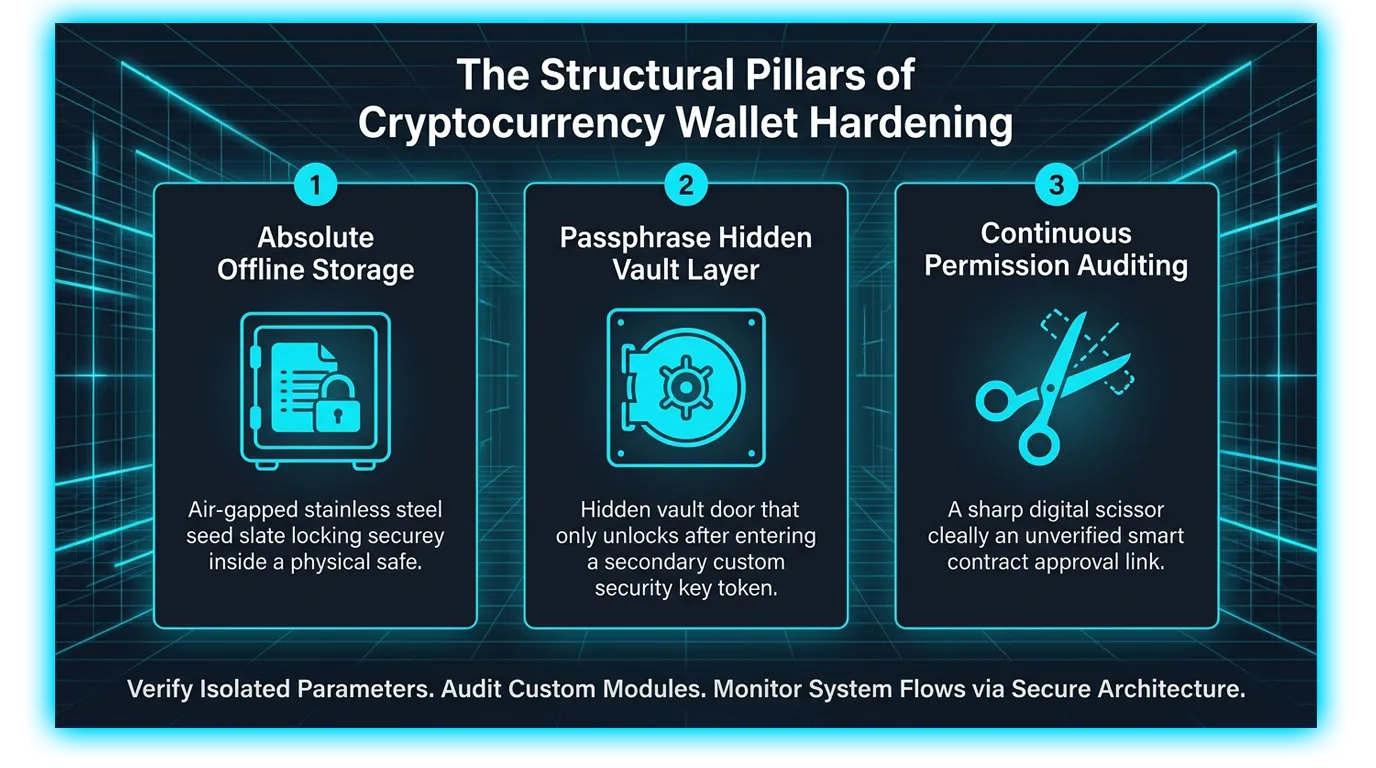
- A 12-to-24-word recovery seed phrase is the master cryptographic key to all generated public addresses on your wallet. If this phrase touches an internet-connected device, its defensive integrity is compromised. Users must never take screenshots of their recovery phrase, save it within digital password managers, text it to alternative accounts, or store it in unencrypted cloud notes applications.
- Sophisticated device malware continuously scans internal local drives and cloud repositories for strings of text or image structures matching standard cryptographic recovery arrays. The phrase must be recorded manually using physical media, ideally stamped or engraved into high-durability stainless steel plates engineered to withstand extreme house fires, structural water damage, and chemical erosion.
3. The Hidden Pocket: Implement a Cryptographic Passphrase
- Standard 12 or 24-word seed phrase sets are vulnerable to physical discovery or coercion. To mitigate this risk, users should configure an advanced Passphrase: frequently referred to as the "25th word." A passphrase is a custom, case-sensitive string of characters appended directly onto your core seed phrase architecture.
- Crucially, entering the passphrase does not simply unlock your standard wallet; it programmatically derives a completely separate, hidden account matrix on the blockchain. If an intruder discovers your physical 24-word sheet or forces access to your safe, they will only see a decoy balance. Your primary capital assets remain completely hidden inside the passphrase-protected layer, which requires both the exact seed phrase and the custom passphrase string to be accessed.
4. The Drills Protocol: Execute a Full Trial Recovery Test
Many self-custody market participants record their recovery phrases in haste, leading to spelling errors, illegible handwriting, or incorrect word ordering. Discovering a faulty backup during an active device failure scenario means permanent asset loss.
Before transferring significant capital to a newly initialized hardware wallet, perform a mandatory trial recovery check:
Deposit a trivial test balance (e.g., five dollars) onto the newly generated address.
Intentionally input an incorrect PIN three times to force the hardware wallet to wipe its internal flash memory completely.
Use your recorded physical backup sheet to restore the keys to the device.
Verify that the restored wallet interface correctly surfaces the exact test balance and address parameters from step one.
5. Risk Layering: Establish a Tiered Wallet Segregation Strategy
- Using a single wallet address for long-term capital preservation, daily trading, and interactive decentralized application (dApp) connections exposes your entire net worth to a single exploit vector. Sophisticated security structures utilize a strict tiered wallet segregation strategy.
- Your primary "Vault" cold wallet should remain completely clean, executing zero smart contract approvals or token signatures. When interacting with unverified protocols, experimental NFT mints, or high-frequency automated market makers, route small, specific sums of capital out to a dedicated software "Burner" wallet to safely isolate potential transaction drain hazards.
6. Physical Verification: Enforce Device-Screen Address Validation
- Modern malware frameworks can intercept operating system functions to execute clipboard hijacking attacks. When you copy a destination wallet address from a web interface, the background malware instantly detects the text format and replaces it in your system clipboard with a visually similar address controlled by an attacker.
- To bypass this exploit vector, users must form an absolute habit of checking every character of the recipient address directly on the hardware wallet’s physical display screen before pressing the final confirmation button. Computer monitors and web browsers can be manipulated by malicious domain front-ends, but the local screen of an air-gapped hardware device reflects the true cryptographic data payload being processed by the internal secure chips.
7. Active Defense: Audit and Revoke Smart Contract Allowances
- When interacting with decentralized finance platforms, applications require you to sign token approvals granting them permission to move specific assets on your behalf. Frequently, interfaces request "infinite spend" approvals to streamline future trading experiences. If that underlying protocol suffers a smart contract exploit, or if the platform front-end is hijacked via a domain routing attack, hackers can use those pre-existing allowances to empty your wallet directly without requiring your current signature.
- Users must treat smart contract permission management as a recurring weekly habit, leveraging trusted, chain-agnostic allowance tracking engines to audit active approvals and completely revoke unneeded or high-risk token allowances.
8. Perimeter Hardening: Secure Local Access and Network Pipes
- Hot wallets running on mobile smartphones or browser extension architectures require dedicated local security hardening to protect the local storage keys from perimeter breaches. Users must enable application-level biometric locks (FaceID/Fingerprint) and unique passcodes across all active wallet instances.
- Furthermore, crypto transactions must never be executed over unsecured public Wi-Fi networks at cafés or airports, as these channels are highly vulnerable to packet skimming, man-in-the-middle exploits, and router-level DNS poisoning. When trading on the go, utilize encrypted cellular data networks or route all application traffic through a trusted, high-performance Virtual Private Network (VPN).
9. Readable Signing: Deploy Pre-Transaction Risk Alerts
- Legacy transaction sign prompts display raw hex data payloads to the user, creating a hazardous environment where participants routinely blind-sign malicious scripts hidden behind fake interface prompts. Modern wallet configurations combat this vulnerability by integrating native, pre-transaction security scanners and risk alert profilers.
- Ensure your active hot wallet software features readable signing extensions that parse incoming call stacks in real time. These modules display clear, human-readable summaries outlining exactly what assets are authorized to leave your wallet, what permissions are being granted to the smart contract, and if the target contract address triggers any active phishing blacklist indicators.
10. Noise Mitigation: Neutralize Dusting Attacks and Poisoning Bait
- On-chain transparency allows malicious entities to execute dusting attacks and address poisoning campaigns at scale. Attackers script automated bots to drop micro-fractions of tokens ("dust") or unexpected promotional tokens directly into your public address. The goal is to pollute your local transaction history registry with addresses that mimic the exact first and last four digits of your typical trading counterparties, baiting you into copying the wrong address from your history panel during future transactions.
- Treat unexpected micro-deposits as toxic security noise: never interact with unfamiliar token drops, never click embedded metadata web links, and always use manual address book whitelisting features rather than relying on historical ledger records.
Universal On-Chain Forensics and Trading Telemetry via DEXTools
- Maintaining an absolute physical defense layer over your private keys must be paired with real-time operational visibility into the external blockchain markets. Utilizing advanced decentralized charting architectures like DEXTools gives market participants an essential universal platform to monitor live token behaviors, evaluate pool depths, and inspect contract parameters across all public execution networks.
- By leveraging core features like the Pair Explorer, Live New Pairs dashboard, Trade Story or Top Traders, technical traders can audit localized volume trends, track large whale wallet capital reallocations via the Big Swap Explorer, and check automated contract safety scores before initiating any on-chain interactions, ensuring your hardened hardware setup interacts safely with verified market venues.
Disclaimer: This article is for informational purposes only and does not constitute investment advice, financial advice, trading advice, or any other kind of advice. DEXTools does not recommend buying, selling, or holding any cryptocurrency or token. Users should conduct their own research and consult with a qualified financial advisor before making any investment decisions. Cryptocurrency investments are volatile and high-risk. DEXTools is not responsible for any losses incurred.
Related Guides
- How to Verify Token Safety Before Buying: A Pre-Buy Crypto Checklist
- How to Analyze Solana Meme Coins Before Trading: On-Chain Risk Checklist (2026)
- DeFi Security Routine: Weekly Checklist for Safer Trading
- Send Crypto From OKX to Coinbase Wallet: Steps 2026
- Send Crypto From Coinbase to Safe Wallet: Steps 2026