What Is Hyperliquid HLP Vault? Strategy Guide 2026
— By Tony Rabbit in Tutorials

Hyperliquid HLP explained: how the vault earns 15-30% APR, deposit steps, risks, JLP vs GLP vs HLP comparison and worked yield example.
Intent check: This page is the HLP-vault strategy guide for Hyperliquid. If you want the broader platform explainer covering architecture and HYPE, read What Is Hyperliquid?. If you want the operational trading walkthrough, read How to Use Hyperliquid.
If you have ever wanted to be the house at a casino instead of the gambler, Hyperliquid HLP is the closest thing crypto offers. HLP is the protocol-owned liquidity vault that sits on the other side of every perpetual trade on Hyperliquid, the largest decentralized perp exchange in the world. Deposit USDC, receive vault shares, and you become a fractional market maker earning the spread, the funding, and the trader losses that flow through the orderbook every second.
In 2026, Hyperliquid clears over three billion dollars of perpetual volume per day. HLP captures a structural share of that activity, historically returning 15 to 30 percent APR sustained, with weekly windows topping 50 percent during high-volatility windows. That puts HLP in a category of its own among passive on-chain yields, ahead of most liquid staking tokens and stablecoin farms.
This guide walks through HLP from the ground up: what it is, how the vault makes money, where the yield comes from, the risks, how to deposit step by step, and how it compares to Jupiter JLP, GMX GLP, and dYdX MegaVault. You will also see a worked example for a ten thousand dollar deposit, a breakdown of returns by source, and a frank look at when HLP printed red ink.
What Is Hyperliquid HLP?
Hyperliquid HLP, short for Hyperliquid Liquidity Provider, is a community-funded vault that provides market making, liquidations, and counterparty liquidity for every perpetual contract on the Hyperliquid exchange. Depositors contribute USDC, receive transferable vault shares, and earn a proportional cut of the vault profits in real time. HLP is the structural backbone of Hyperliquid liquidity.
Unlike a passive AMM, HLP runs a portfolio of active strategies. A primary market making strategy quotes both sides of every major perp book. A liquidation engine absorbs positions that breach their maintenance margin. A funding-rate harvesting strategy collects the periodic payments that imbalanced markets generate. All three flows accumulate into the vault NAV, which is marked to market once per second.
The vault is permissioned only in the sense that the Hyperliquid Foundation publishes the on-chain strategy parameters. Anyone can deposit. Anyone can withdraw after a seven-day unbonding period. Anyone can even spin up their own sub-vault on Hyperliquid using the same vault infrastructure, copying or modifying HLP's behavior to create a competing strategy. That openness is what makes HLP different from a centralized market making desk.
The Hyperliquid Architecture: Why HLP Exists
To understand why HLP matters, you need to understand how Hyperliquid is built. Most decentralized perp exchanges use one of two models. The first is an orderbook with external market makers, like dYdX. The second is a virtual AMM with a liquidity pool counterparty, like GMX. Hyperliquid takes a third path: a fully on-chain orderbook backed by a protocol-owned vault that always quotes alongside human and bot traders.
Every trade on Hyperliquid settles through HyperBFT consensus on a custom Layer 1 optimized for trading. The exchange operates a price-time priority limit orderbook with sub-second matching, and HLP runs algorithmic strategies that constantly post bids and asks. When a retail user opens a long on BTC-PERP, the counterparty might be a professional bot, another user, or HLP. When the book is thin, HLP fills the gap. This is why traders consistently see zero slippage relative to the oracle on Hyperliquid even on size, and it is also why HLP earns yield.
The economic flow is simple. Traders pay maker and taker fees. Funding payments transfer between longs and shorts. Liquidations create discounted entries. Spreads create realized profit on round-trips. HLP captures a slice of every one of these flows by being the universal counterparty when needed. The protocol does not subsidize HLP. The vault earns its returns from real trading economics on a real exchange.
A Brief History of HLP and Hyperliquid
Hyperliquid launched its public testnet in mid-2023 with an explicit goal: build the fastest fully on-chain perp exchange. The founders, operating largely under the pseudonym "Jeff", refused outside venture capital. Every dollar of vault depth would come from real users, not insider allocations. HLP was the answer to a hard question: how do you bootstrap orderbook depth without giving market making rights to a single firm?
The answer was a community vault open to anyone with USDC. Depositors would collectively own the protocol's primary market maker. The vault crossed one hundred million in TVL in 2024 and then climbed past five hundred million by late 2025.
The defining moment came in November 2024 when Hyperliquid airdropped 31 percent of the HYPE token supply to community members, with aggressive allocations to active traders, vault depositors, and referrers. The airdrop is considered one of the largest fair launches in crypto history. HLP TVL doubled in the weeks after the airdrop as new users recycled windfall HYPE back into the vault. By Q1 2026 Hyperliquid was clearing more daily perp volume than every other DEX combined, and HLP became the highest-volume single liquidity provider in onchain derivatives.
How HLP Actually Makes Money: The Three Strategy Stack
To value HLP you need to look at its profit and loss sources individually. The Hyperliquid Foundation publishes the high-level strategy mix and a rolling per-strategy PnL. In aggregate, HLP runs three engines simultaneously, and each contributes differently to the headline APR. Understanding this breakdown is the difference between thinking of HLP as a black box and thinking of it as a portfolio you can stress test.
1. Market Making (around 55 to 65 percent of profit)
HLP's largest strategy is symmetric two-sided liquidity provision on the top perpetuals: BTC, ETH, SOL, HYPE, and the deep-book pairs. The algorithm updates bid and ask quotes around a fair value derived from a robust oracle index, widening when volatility spikes and tightening when conditions are calm. Every round-trip, when a taker hits HLP's bid and another taker hits the ask, the vault collects the spread. On liquid pairs the spread is just a few basis points but adds up across millions of fills per day.
The engine is inventory-aware. When HLP accumulates a long position from buy pressure, the algorithm skews quotes lower to encourage offloading and reduce directional exposure. HLP holds modest net delta most of the time, but it is never fully delta-neutral. Some of the yield comes precisely from being willing to take inventory the rest of the market does not want.
2. Liquidation Engine (around 15 to 20 percent of profit)
When a Hyperliquid trader's position breaches its maintenance margin, the exchange automatically closes the position. HLP is the default counterparty for most liquidation fills, absorbing the trader's residual margin into vault NAV. The size of this contribution scales with volatility. In flat markets liquidations are rare. In violent down moves on alts the liquidation channel can deliver more in a single weekend than market making does in a month. If you understand liquidation zones, you get the dynamic: HLP collects the wreckage that overleveraged traders leave behind.
3. Funding Rate Capture (around 15 to 25 percent of profit, variable)
Perpetuals use periodic funding payments to anchor contract price to spot. When the book is heavily long, longs pay shorts. When heavily short, shorts pay longs. HLP's funding engine positions on the receiving side where statistical models indicate the imbalance is persistent enough to overcome the directional risk. In crab markets funding is a small contributor. In strong directional regimes funding can deliver double-digit annualized rates on the engaged capital. It is also the most likely strategy to print short-term losses when the spot move outruns the funding adjustment.
HLP APR in 2026: A Realistic Breakdown
The single most asked question about HLP is "what is the real APR?" The honest answer is "it depends on the volatility regime", but we can give a precise framework for thinking about it. As of the rolling twelve-month window ending Q2 2026, HLP has delivered approximately 22 percent net APR. The standard deviation of monthly returns annualizes to roughly 14 percent. That means in any given month the vault could plausibly return anywhere between minus 1 percent and plus 4 percent.
Here is the decomposition that matters. Of that 22 percent, roughly 12 to 13 percent comes from market making spread capture. Around 4 to 5 percent comes from the liquidation engine. The remaining 4 to 6 percent comes from funding rate capture, with significant variation. Compare that to the headline numbers people throw around on Twitter: "HLP did 80 percent APR last week." That is a real number for a short window, but extrapolating it twelve months forward is a mistake. Spike weeks are exactly that. Spike weeks.
12-13% of the 22% APR. The most stable contributor. Bid/ask spread captured millions of times per day.
4-5% of APR baseline. Spikes dramatically during sell-offs and parabolic moves. Free yield on volatility.
4-6% of APR average. Most variable contributor. Earns when one side of the book is structurally crowded.
During FOMC, CPI, hack-driven liquidations, weekly APR can hit 40-80% for 5-10 day windows.
Worked Example: What a 10K USDC Deposit Looks Like
Concrete numbers help. Suppose you deposit ten thousand USDC into HLP today. Based on the trailing 365-day APR of approximately 22 percent net of vault costs, twelve months in your vault shares are worth roughly 12,200 USDC. That is 2,200 USDC of yield with no leverage, no token speculation, no impermanent loss, and no active management.
But "expected" is doing real work. The realized outcome depends on the volatility regime. In a tame year like mid-2025, HLP returned closer to 16 percent net, which on 10K is 1,600 USDC. In a volatile year like late 2024 around the airdrop, the trailing return was over 32 percent net, which is 3,200 USDC. Both are bracketed by the structural model.
Compare to an Aave USDC deposit at 6 percent (600 USDC), a major stablecoin farm at 8 percent (800 USDC), or a US Treasury bill at 5 percent (500 USDC). HLP roughly triples the yield of safe stablecoin alternatives, in exchange for non-trivial tail risk and a seven-day unbonding period.
HLP vs JLP vs GLP vs MegaVault: The Vault Comparison
HLP is not the only liquidity-provider vault that has captured attention this cycle. Jupiter JLP on Solana, GMX GLP on Arbitrum and Avalanche, and dYdX MegaVault on the dYdX Chain are the obvious comparables. Each one runs a different design with materially different risk and return profiles.
Jupiter JLP is a basket vault on Solana made up of SOL, ETH, WBTC, USDC, and USDT in fixed target weights. JLP earns from Jupiter exchange fees and trader losses, but is not delta-neutral. Holders carry the directional risk of the underlying basket. If SOL drops 20 percent, JLP drops in dollar value even while it accrues yield. JLP is more a leveraged-long-crypto-with-yield bet than a pure market making play.
GMX GLP launched on Arbitrum in 2021 as the original protocol-owned liquidity vault. GLP is also a multi-asset basket carrying directional exposure. The basket model is structurally lower yield than HLP's active strategy approach, with APR in the 8 to 15 percent range.
dYdX MegaVault launched in 2024 on the dYdX Chain. It is closer to HLP in philosophy: a pooled vault allocating capital across sub-vaults run by professional market makers. The dYdX chain has lost share to Hyperliquid throughout 2025 and 2026, so the volume base supporting MegaVault is smaller. APR averages 10 to 18 percent.
Hyperliquid HLP is the largest of the four by TVL and runs on the highest-volume venue. It is structurally closer to delta-neutral than JLP or GLP because the market making strategy hedges out most directional exposure within seconds. Yield comes from operational edge rather than from holding the underlying. HLP can have a bad week from a sharp move that whipsaws inventory management, but it does not have a "SOL down 30 percent" problem the way JLP does.
When HLP Has Lost Money: An Honest History
If somebody pitches you HLP as risk-free yield, walk away. There have been multiple weeks in HLP's history where the vault drew down. The realized track record is the best way to understand the worst-case envelope.
The most notable drawdown occurred in March 2024 during a rapid Bitcoin rally. Hyperliquid users on aggregate were positioned correctly for the move, which meant HLP, as the counterparty, accumulated short inventory that lost on the rally before the inventory management algorithm could rebalance. The vault closed that week down approximately 1.4 percent on NAV. It recovered fully within ten days as funding flipped and spread capture resumed.
A similar episode happened in October 2025 around a major ETF announcement that triggered a violent gap higher in ETH and SOL. HLP printed a 0.9 percent down week. Smaller red days happen on a roughly biweekly basis. In every cycle to date the vault has recovered, but the lesson is that HLP yield is real and so is HLP volatility. The mean drift is positive and the variance is non-trivial. HLP does not literally win every time a trader loses, but on net across the universe of Hyperliquid trades more traders close in red than green, and HLP captures a structural share of that net flow.
Step-by-Step: How to Deposit Into HLP
Depositing into HLP is straightforward once you have a Hyperliquid account funded with USDC. The whole process takes under five minutes for a first-time user. Here is the exact sequence.
Step 1: Set up a Hyperliquid account
Go to app.hyperliquid.xyz and connect a wallet. Hyperliquid supports MetaMask, Rabby, Coinbase Wallet, and most Ethereum-compatible wallets. You will sign a one-time message to derive your Hyperliquid trading agent key, which is a separate session key the exchange uses for fast signing. Your funds remain controlled by your main wallet's private key. Review the wallet permission carefully and check the address. Address poisoning is real, so if you are unsure how to protect yourself, read our guide on how to avoid crypto address poisoning scams.
Step 2: Bridge USDC to Hyperliquid
Hyperliquid's native USDC bridge moves USDC from Arbitrum (the default deposit chain) onto the Hyperliquid L1 in a single transaction. Confirm the bridge, wait for confirmation, and the balance appears in your Hyperliquid spot wallet. If you do not yet have USDC, you can buy it on a centralized exchange, withdraw to Arbitrum, then bridge. Cross-chain routing tools like 1inch can also route from other chains directly.
Step 3: Navigate to the Vaults tab
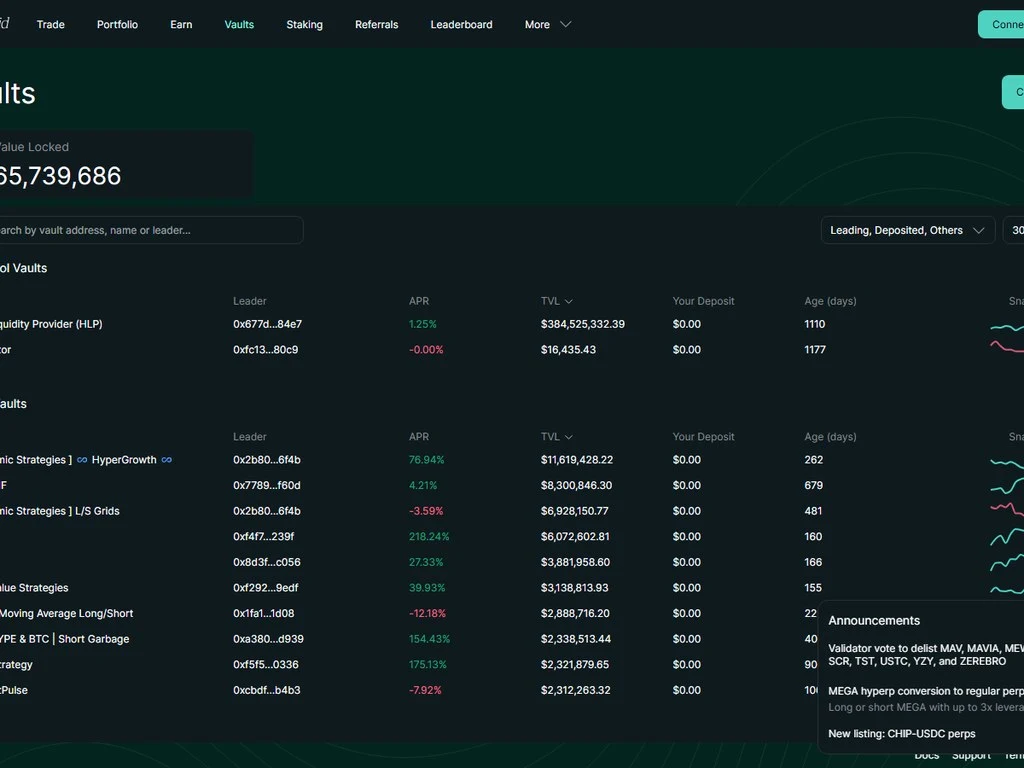
From the Hyperliquid app top nav, click "Vaults". You will see HLP listed at the top as the protocol vault, along with community sub-vaults that anyone can run. Click HLP to open the vault detail page, which shows current TVL, trailing 7-day and 30-day PnL, position breakdown across markets, and the current APR estimate.
Step 4: Deposit USDC
Click "Deposit". Enter the USDC amount you want to commit. Confirm in your wallet. The deposit settles within seconds and you receive HLP vault shares pegged to the current NAV per share. Your dashboard now shows your position, current unrealized PnL, and a countdown clock for the seven-day unbonding window that begins from your most recent deposit.
Step 5: Monitor and withdraw when ready
From the vault page you can track your PnL second-by-second. When you want to withdraw, click "Withdraw". The amount is queued. After the seven-day unbonding completes, the USDC returns to your Hyperliquid spot wallet. You can then bridge back to Arbitrum or trade with the funds on Hyperliquid. Note that if you redeposit during the unbonding window the clock resets, so plan accordingly.
The Seven-Day Unbonding Period: Why It Exists
The seven-day withdrawal cooldown is the most-criticized feature of HLP and also the one that most clearly explains how the vault produces stable yield.
Without an unbonding period, a depositor could see HLP take a drawdown on a bad week, hit "Withdraw", and exit immediately at the depressed NAV. The remaining depositors would absorb the loss at full force. Over time this dynamic would cause flight risk at exactly the wrong moments, and the vault could enter death spirals where each drawdown caused a TVL hemorrhage that compounded the loss.
The seven-day cooldown makes the asset behave more like a closed-end fund during stress windows. You commit capital for at least seven days at a time. By the time a queued withdrawal processes, the market context has usually moved and the drawdown that triggered your withdrawal request has partially or fully recovered. From a depositor perspective: if you might need the cash inside a week, do not deposit. If you are parking capital for weeks or months, the cooldown is a non-issue and actually helps because everyone else's cooldown is what keeps the vault stable enough to pay you yield.
HYPE Token and Builder Codes
HYPE launched via the November 2024 community airdrop. Roughly 31 percent of the genesis supply (3.1 billion tokens out of 10 billion total) went to historical traders, vault depositors, and active referrers based on a testnet points system. There were no venture allocations and no insider unlocks of the airdrop tranche. HYPE peaked in 2025 above 35 USD per token and trades around 28 USD in mid-2026.
HYPE is the gas token for the Hyperliquid L1, the staking asset for the validator set, and the governance asset for protocol decisions including vault parameter changes. HLP depositors do not need HYPE to deposit or withdraw (those settle in USDC), but a portion of trading fee revenue buys back HYPE on the open market, creating a feedback loop between exchange volume, HLP profitability, and HYPE valuation.
Builder codes are Hyperliquid's referral and embedded UI system. Any developer can build a custom interface on top of the Hyperliquid orderbook, register a builder code on-chain, and earn a share of fees from users who route through their UI. This has produced a thriving ecosystem of Hyperliquid-powered apps: copy-trading dashboards, mobile-first clients, custom analytics overlays. HLP benefits because more builders means more total order flow for the vault to intermediate.
Anyone Can Run a Sub-Vault
One of Hyperliquid's quietest but most powerful features is that the vault infrastructure is open to everyone. Any user can deploy a sub-vault, set their strategy, accept deposits, and earn a performance fee on the alpha they generate. This is the structural reason HLP stays competitive: if it underperforms, capital can rotate into community-run vaults doing better.
Dozens of community sub-vaults exist in 2026. Some are run by professional trading firms operating semi-anonymously, some are quant strategies built by individual developers, some are simple long-only trend followers anyone can copy-trade. The leaderboard is public, with trailing returns and live positions visible. Smart depositors often allocate across multiple vaults, with HLP as the conservative anchor. JLP, GLP and MegaVault all run a single protocol-controlled strategy. Hyperliquid runs a vault marketplace. If active management interests you, our guide on backtesting trading strategies is a useful starting point.
HLP vs Other Passive On-Chain Yields
To position HLP correctly it helps to compare it against the broader universe of passive on-chain yields.

Stablecoin lending (Aave, Compound, Morpho): Returns 4 to 8 percent on USDC. Smart contract and bad-debt risk. Liquidity is instant. HLP delivers roughly three times the yield with higher operational risk.
Liquid staking (Lido, Rocket Pool, Jito): ETH or SOL staking returns 3 to 7 percent in the native asset with directional exposure to the underlying. See our Rocket Pool rETH guide. HLP yields more but does not give you upside on ETH or SOL price appreciation.
Tokenized treasuries (Ondo USDY, OUSG): 4 to 5.5 percent backed by US T-bills, the lowest risk on-chain yield available. See our coverage of Ondo Finance and RWA tokenization. HLP triples the yield in exchange for trading-related risk.
Stablecoin farming (Curve, Convex, Pendle): 6 to 25 percent, often token-emission-juiced rather than organic. HLP is fully organic with no emissions inflating the headline.
HLP occupies a distinct slot: organic, USDC-denominated, double-digit, with non-trivial drawdown risk. A common construction is a barbell: most of your stables in low-risk Aave or Ondo, a satellite allocation in HLP for return enhancement.
HLP Risks: An Honest Reckoning
HLP yield is real, but so are the risk vectors. Five risks deserve explicit attention.
Smart contract risk: Hyperliquid runs a custom Layer 1 with custom matching engine code. The codebase has been audited and the protocol has handled multi-billion dollar volume without major incident, but it is still less battle-tested than the most established Ethereum DeFi protocols. A bug in the vault accounting code or matching engine could in principle cause loss.
Strategy risk: If HLP's market making and inventory algorithms misjudge a regime change, the vault can take a serious drawdown in a single week. Historical max drawdown has been around 1.5 percent in a week, but a 5 percent or larger drawdown over a short window is not impossible.
Counterparty composition risk: If Hyperliquid traders systematically become more skilled over time (smarter bots, better tools), the structural edge that HLP enjoys as net counterparty could erode. So far the opposite has happened, with retail volume growing faster than alpha generation, but it is a long-tail risk worth tracking.
Unbonding risk: The seven-day cooldown means you cannot exit during a stress event. If a real protocol issue emerges, you may have to ride out the resolution. Position-size accordingly.
Regulatory risk: Hyperliquid operates in a gray zone for many jurisdictions. The HLP vault has structural similarities to a pooled investment vehicle, and a regulatory determination in a major jurisdiction could affect access for users in that region. The exchange has so far operated permissionlessly with geofencing for some products, but the landscape continues to evolve.
Real Hyperliquid Stats: The 2026 Scoreboard
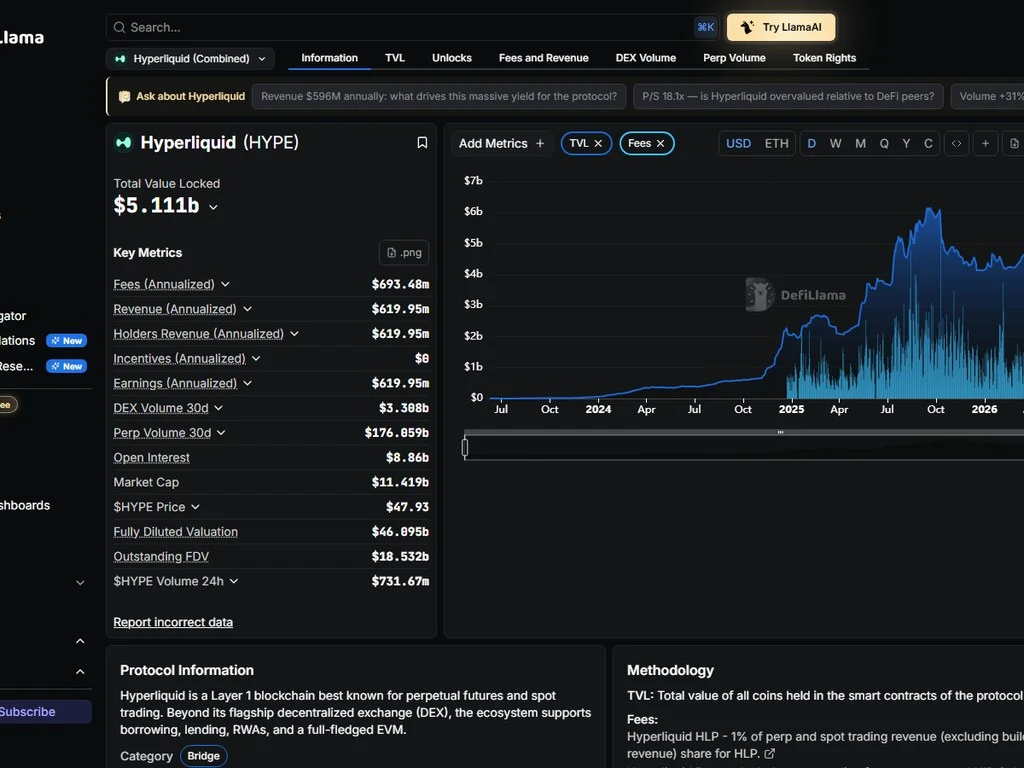
Some numbers from the Q1-Q2 2026 window. Hyperliquid daily perp volume averages 3.2 billion USD, peaking above 7.5 billion. Daily traders regularly exceed 80,000 unique addresses. Open interest across 150+ perp pairs hovers around 4.5 billion USD. HLP TVL trades between 600 million and 1 billion USD. Hyperliquid's market share of decentralized perp volume is over 70 percent, ahead of GMX, dYdX, ApolloX and the rest combined.
HYPE is consistently in the top 25 cryptocurrencies by market capitalization in 2026, with daily spot volume above 500 million USD. The buyback flywheel from exchange fees is measurable in price action: every spike in trading volume corresponds to a step up in protocol revenue used for buybacks. For HLP specifically, the protocol publishes daily PnL by strategy, per-market position dashboards, and historical performance with two-second resolution, a level of transparency unmatched in traditional finance.
Pros and Cons of HLP
- Organic double-digit USDC yield with no token emissions
- Delta-managed, minimal directional crypto exposure
- Counterparty to the largest perp DEX in the world
- Three diversified strategy engines inside one vault
- Full transparency: per-second PnL, open positions, history
- Permissionless access, no KYC, no minimum deposit
- Seven-day unbonding period blocks fast exits
- Vault can lose money in violent trend weeks
- Less battle-tested than legacy Ethereum DeFi
- USDC-denominated only, no upside on crypto rallies
- Regulatory uncertainty in some jurisdictions
- Requires bridging USDC to Hyperliquid L1
Practical Allocation Strategies
If HLP belongs in your portfolio, sizing matters. Three common allocation patterns observed in the on-chain community:
Conservative satellite (5 to 10 percent of stables): HLP as a yield enhancer on a small slice. The rest stays in tokenized treasuries or Aave. Right for portfolios where preservation is the priority.
Balanced barbell (25 to 35 percent): Larger allocation that meaningfully tilts portfolio yield higher. Pair with safer assets to keep total drawdown bounded.
Aggressive deployment (40+ percent): Used by traders who view HLP as a core position and supplement with active sub-vault strategies. Only appropriate with significant on-chain experience.
In every case, do not deploy capital you cannot leave parked for at least a couple of months. The combination of the seven-day cooldown and natural drawdown recovery time means short horizons fight against you. HLP is a medium-duration yield position, not a checking account.
Future of HLP and Hyperliquid
The Hyperliquid Foundation has indicated plans to expand vault strategy diversity, potentially adding options market making, basis trading between perps and spot, and cross-venue arbitrage. Each new strategy expands the yield base without diluting depositors.
Spot trading on Hyperliquid keeps growing with more listings, creating new spread capture opportunities. Competition will intensify: Drift, Aevo and Lighter are pursuing similar vault designs. None has HLP's order flow yet, but the moat is volume, and volume can shift. For depositors, the practical implication is that HLP yield in 2027 may be lower than 2026 if more capital crowds into the strategy, or higher if perp volume keeps outpacing TVL growth. Either way the structural appeal of organic, USDC-denominated, double-digit yield will continue to attract attention. Understanding the role of a market maker in crypto gives you most of the mental model you need: HLP is a pooled, productized version of what a professional trading firm does.
Frequently Asked Questions
Q What is Hyperliquid HLP in simple terms?
HLP is a community-funded vault that serves as the main market maker and counterparty for trades on the Hyperliquid perpetual exchange. Depositors contribute USDC, receive vault shares, and earn a proportional share of the profits the vault makes from spreads, liquidations, funding rate capture, and net trader losses on the exchange. Think of it as becoming a fractional owner of the trading desk that takes the other side of every Hyperliquid trade.
Q What is the typical HLP APR in 2026?
HLP has averaged approximately 22 percent net APR over the trailing twelve months ending Q2 2026, with a typical range between 15 and 30 percent depending on volatility regime. Short windows can spike well above 40 percent during high-volatility events, and individual weeks can also print red. The yield is organic, paid in USDC, and does not come from token emissions.
Q Where does HLP yield actually come from?
Three sources. Roughly 55 to 65 percent of profit comes from market making spread capture across the perp orderbooks. Around 15 to 20 percent comes from liquidations where HLP absorbs failed positions at favorable prices. The remaining 15 to 25 percent comes from funding rate capture, which is the most variable contributor. All three flows are real trading economics, not token incentives.
Q Can HLP lose money?
Yes. HLP has experienced negative weeks throughout its history, with the largest weekly drawdown around 1.4 percent during a sharp rally in March 2024 and a similar dip in October 2025 around an ETF announcement. Single-day red prints happen on a roughly biweekly basis. The vault has always recovered, but it is not risk-free, and a depositor needs to be comfortable holding through drawdown windows.
Q How long is the HLP withdrawal cooldown?
Seven days. After you queue a withdrawal, your USDC returns to your Hyperliquid spot wallet after the seven-day unbonding period elapses. The cooldown exists to prevent flight risk during stress events and to make HLP behave more like a stable market making fund than a hot-money pool. If you redeposit during the window the timer resets, so plan your exits carefully.
Q How is HLP different from Jupiter JLP?
HLP holds USDC plus active perp positions managed for delta neutrality. It is structurally a market making product with minimal directional exposure. JLP holds a fixed basket of SOL, ETH, BTC, USDC, and USDT, meaning JLP holders carry the directional risk of the underlying basket. JLP can deliver higher headline yield in bull markets but also drops in dollar value when crypto drops, while HLP stays more dollar-stable.
Q Is there a minimum deposit for HLP?
No formal minimum. You can deposit any amount of USDC, including small test amounts. Practical minimums are set by the bridge and gas costs: depositing 20 USDC technically works but is dominated by transaction friction. Most users deposit at least 500 USDC for the math to make sense, with no upper limit other than the vault's available capacity.
Q Do I need to hold HYPE to deposit into HLP?
No. HLP deposits and withdrawals are denominated in USDC. You do not need HYPE to participate. However, HYPE is the gas and governance token for the Hyperliquid L1, and a portion of exchange fees is used to buy back HYPE, so HLP performance and HYPE valuation are economically linked even if you do not hold HYPE directly.
Q Is HLP safe? What are the main risks?
Five key risks. Smart contract risk in the Hyperliquid L1 codebase. Strategy risk if vault algorithms misjudge a regime change. Counterparty composition risk if traders become structurally more profitable. Unbonding risk because you cannot exit instantly during stress. Regulatory risk in jurisdictions that may classify pooled vaults as investment vehicles. None of these are unique to HLP but they are real, and HLP is less battle-tested than legacy DeFi protocols.
Q Can I trade or transfer HLP vault shares?
HLP shares are accounted on the Hyperliquid L1 and are tied to your account. They are not freely transferable as ERC-20 tokens. Withdrawal back to USDC is the standard exit path, subject to the seven-day cooldown. This is intentional. Free transferability would create the same flight risk that the cooldown is designed to prevent.
Q How do builder codes affect HLP?
Builder codes let developers build custom UIs on Hyperliquid and earn a share of trading fees from users who route through their interface. They expand the overall order flow reaching the exchange, which means more volume for HLP to intermediate and more total yield generation for vault depositors. HLP depositors benefit indirectly from a healthy builder ecosystem because total volume drives total vault revenue.
Q Can anyone run their own vault on Hyperliquid?
Yes. Hyperliquid's vault infrastructure is permissionless. Any user can deploy a sub-vault, define their strategy, accept deposits from other users, and earn a performance fee on outperformance. Dozens of community sub-vaults exist in 2026, with full transparency on returns and positions. This open design forces HLP to remain competitive on returns and makes Hyperliquid effectively a vault marketplace, not just a single-product venue.
Conclusion: Should You Deposit in HLP?
Hyperliquid HLP represents one of the most interesting innovations in on-chain yield in the current cycle. It packages the economics of professional market making, liquidation farming, and funding rate capture into a single permissionless USDC vault that anyone can access. The realized track record is strong, the transparency is unmatched, and the yield is organic rather than emission-driven.
That said, HLP is not a savings account. The seven-day unbonding period, the strategy drawdown risk, and the still-evolving regulatory landscape are real considerations. Sizing matters. Time horizon matters. And the right way to think about HLP is as a satellite allocation within a broader on-chain portfolio, not as the foundation of one. Pair HLP with safer building blocks like tokenized treasuries and stablecoin lending, treat it as a yield enhancer, and you have a thoughtful portfolio construction.
If after reading this you want to take the next step, the path is simple. Set up a Hyperliquid account, bridge a test amount of USDC, deposit into HLP, and watch the vault for a few weeks to develop a feel for how it behaves. Most depositors find that the day-to-day experience is calmer than the headline yield suggests, with steady drips of NAV growth punctuated by occasional volatility. That is exactly the profile a well-designed market making vault should produce, and it is what makes HLP one of the most discussed yield products in DeFi in 2026.
For continued reading on adjacent topics, our guides on long versus short positioning in crypto, Pyth oracle pricing, and DeFi fundamentals give you the broader context you need to evaluate HLP and its competitors with sharper eyes. The on-chain yield landscape moves fast. Building the mental models to track it pays dividends well beyond any single vault deposit.