What Is World Chain? Worldcoin's L2 Complete Guide 2026
— By Tony Rabbit in Tutorials
World Chain explained: Worldcoin's OP Stack L2 with World ID priority blockspace, WLD grants, Orb verification, top dApps, risks, and step-by-step guide.
World Chain is one of the most unusual experiments in Layer 2 scaling. While other rollups race to compress more transactions per second, World Chain takes a different bet. It rebuilds the gas market around verified human identity. Launched in October 2024 by Tools for Humanity, the company co-founded by Sam Altman, World Chain treats real people as a first-class resource. Bots still exist, but they pay more, wait longer, and never get priority. Humans (verified through an iris scan at a device called the Orb) get cheaper, faster, prioritized blockspace.
World Chain is an OP Stack rollup that settles to Ethereum, sits inside the Optimism Superchain, and runs a custom block builder that reorders transactions by humanity score. Above the chain sits World App, a mobile wallet that has quietly become one of the largest Mini App platforms in crypto. Below it sits a controversial biometric identity layer, with regulators in Spain, Germany, Kenya, South Korea, and Hong Kong alternately welcoming, suspending, or banning the Orb operation.
This guide walks through every layer of the World Chain stack: how the rollup works, what Priority Blockspace for Humans does at the sequencer level, how WLD grants are distributed every two weeks, which dApps run on the chain in 2026, and how World Chain compares with Base and Linea. By the end you will understand what Worldcoin built, why some governments banned it, and how to use the World App.
What Is World Chain?
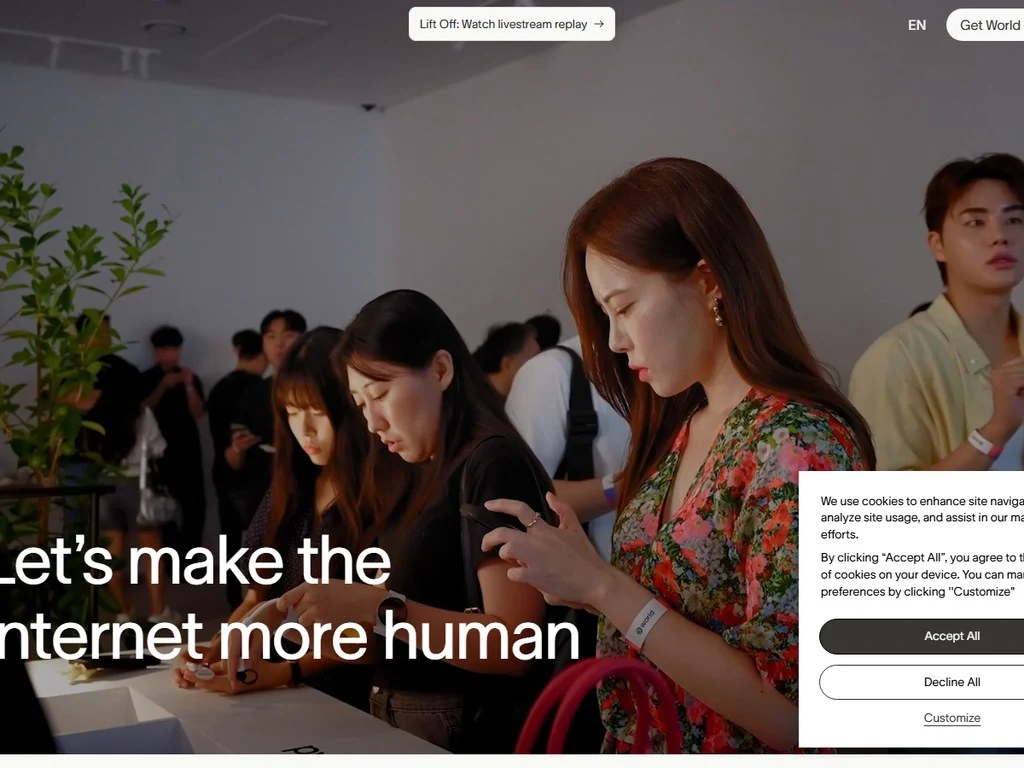
World Chain is an Ethereum Layer 2 rollup built on the OP Stack by Tools for Humanity, the developer of the Worldcoin protocol. It launched its mainnet in October 2024 and is designed around a unique premise: verified humans receive priority transaction inclusion and partially subsidized gas. Identity is verified off-chain through a proof-of-personhood device called the Orb, and a zero-knowledge credential (World ID) is then carried on-chain.
The chain settles to Ethereum, inherits Ethereum security, joins the Superchain shared sequencing roadmap with Base and OP Mainnet, and supports any Solidity contract that already runs on Optimism. WLD, the network's native economic token, doubles as the gas-subsidy fuel and the grant currency paid to verified humans. The result is a general-purpose EVM L2 with a sybil-resistant user layer baked in at the protocol level.
The History Behind World Chain and Worldcoin
Worldcoin was incubated between 2019 and 2021 by Sam Altman, Alex Blania, and Max Novendstern. Altman, who would later become OpenAI's chief executive, framed the project as a hedge for a world in which artificial general intelligence makes it impossible to distinguish humans from bots online. The team's answer was an iris-scanning hardware device, the Orb, that creates a unique biometric hash without storing the underlying image.
Tools for Humanity (TFH) was incorporated in 2020, with offices in Berlin, San Francisco, and Erlangen. First Orbs were field-tested in Chile, Indonesia, Kenya, and the US during 2021-2022. The WLD token went live on Optimism in July 2023, alongside the World App. By late 2023 the team had decided a general-purpose L2 dedicated to verified users would scale better than living as a tenant on Optimism, and World Chain was announced at Permissionless in April 2024.
World Chain mainnet went live on 22 October 2024 with around 100 partner applications. The cumulative number of unique humans verified through Orbs crossed 6 million by early 2026, across more than 30 countries where the Orb is permitted to operate. The Worldcoin Foundation, registered in the Cayman Islands, governs the protocol and the WLD token, while Tools for Humanity remains the lead engineering contributor.
How World Chain Works Under the Hood
Mechanically, World Chain is a standard OP Stack rollup. Transactions are submitted to a sequencer, batched into compressed blobs using EIP-4844 blob space, and posted to Ethereum L1 for data availability. State proofs follow Optimism's fault-proof model. Anyone can run a node, anyone can reproduce the state, and anyone with valid fault proofs can challenge an invalid state root within the seven-day challenge window. So far this is identical to Base, OP Mainnet, Mode, Zora, and the other Superchain members.
The interesting part is what happens before a transaction reaches the sequencer. World Chain modifies the transaction ordering layer to recognize a World ID credential. When a transaction is signed by a wallet whose owner has a valid World ID, the sequencer assigns it to a separate priority lane. This lane has guaranteed inclusion, partial gas subsidy from the protocol treasury, and protection from being deprioritized by higher-fee bot transactions during congestion.
Bots and unverified wallets are not banned. They still get to use the chain, they just pay full gas, they never enter the priority lane, and they receive a smaller share of the block during contention. From an MEV perspective, the verified human's transaction always lands first in the block ordering, which makes sandwiching a human's swap with a bot-driven attack structurally harder than on a vanilla EVM rollup.
World ID: Proof of Personhood at Layer 1 of the Stack
World ID is the credential that gates priority access. To get one, a person stands in front of an Orb (a chrome-finished sphere with a multispectral camera), and the device captures a high-resolution image of both irises. The image never leaves the device. Instead, a neural network on the Orb hardware converts the iris pattern into a 12,800-bit code called an "iris code," then hashes that code with a one-way function. Only the hash is sent off the Orb. The hash gets compared against the registry of existing hashes, and if no collision is found, a new World ID is minted.
The credential lives on World Chain as a zero-knowledge proof. When a user wants to prove humanity to a dApp, the World App generates a Semaphore-style ZK proof attesting that "this signer belongs to the set of all verified humans" without revealing which human. The dApp checks the proof, the user keeps full unlinkability across applications, and the iris code itself never leaves the Orb.
Priority Blockspace for Humans (PBH)
Priority Blockspace for Humans, often shortened to PBH, is the mechanism that makes World Chain different from every other L2. PBH reserves a portion of every block exclusively for transactions signed by World ID holders. At launch the reserved share was 50 percent of the block gas limit, with a soft cap of one priority transaction per human per epoch (currently around 30 minutes).
The subsidy itself comes from the World Chain treasury, which holds a portion of the WLD allocation reserved for protocol operations. Every priority transaction triggers a partial refund of the L2 base fee back to the user, executed automatically by the sequencer. In practice this means that a verified human swapping tokens on World Chain in 2026 pays around 30-60 percent less in fees than the same swap by an unverified address. The exact subsidy ratio is governed by a public parameter that the Worldcoin Foundation adjusts based on treasury balance.
There is one important caveat. PBH only applies to transactions whose origin is the human's own EOA. If you script a bot to use your World ID, the bot still benefits from priority. This is by design (humans are allowed to delegate or automate their own activity), but it does mean PBH protects identity, not behaviour. A determined Sybil farm with thousands of paid verifiers could in theory game the priority lane. The economic cost of running 1,000 Orb verifications, however, vastly exceeds the realistic profit, which is the deterrent the design relies on.
WLD Tokenomics in Detail
WLD is the native token of the World network. It launched in July 2023 with a hard maximum supply of 10 billion units, denominated in the Worldcoin Foundation's smart contract on Optimism, with a bridge to World Chain. The vesting schedule extends over 15 years from genesis. At the May 2026 cut-off, around 2.1 billion WLD are in circulation, with the rest locked behind various time gates.
The allocation is split roughly as follows: 75 percent to the Worldcoin community (which includes grants to verified humans, ecosystem incentives, and Foundation operations), 13.5 percent to early investors, 9.8 percent to the Tools for Humanity team and contributors, and 1.7 percent reserved for future operational use. Investor and team tokens follow a one-year cliff plus a four-year linear vesting from July 2023, meaning the largest unlock pressure was concentrated in 2024 and tapers off significantly through 2027.
The most novel part of the tokenomics is the grant program. Every verified human who completes Orb verification becomes eligible to claim a recurring WLD grant. As of 2026 the standard grant pays roughly 3 WLD every two weeks, with the exact amount adjusted by the Foundation based on price and supply targets. The grant is paid into the user's World App wallet automatically and can be claimed with a single tap. Users can also receive supplementary grants for completing specific activities (using a partner dApp, holding a Mini App badge, attending an event), funded by ecosystem partners rather than the core treasury.
WLD is used for three things on World Chain. First, as gas, although the network accepts ETH as well and ETH remains the more commonly used unit for raw fees. Second, as the unit of account for grants. Third, as the medium for ecosystem partnerships and Mini App rewards. Holding WLD is not required to use World Chain, but holding some becomes natural for anyone receiving grants. For broader context on how a token's supply structure can shape its market behaviour, our explainer on market cap formulas and unlock pressure is a good companion read.
World App: The Super-App Above the Chain
If World Chain is the highway, the World App is the car that almost everyone drives on it. World App is the official mobile wallet built by Tools for Humanity, available on iOS and Android. It does the standard wallet things (custody keys, sign transactions, swap tokens, send WLD to other users) but it adds two unusual layers: a Mini App platform and an integrated identity flow.
Mini Apps are full applications embedded inside World App. They are written in HTML, JavaScript, and the World App SDK, and they run inside a webview with a permissioned bridge to the user's wallet. From a user perspective there is no difference between opening a native app and opening a Mini App, except that Mini Apps install instantly with no app store review and inherit the user's identity automatically. This is the same model that WeChat used to build its super-app moat in China, applied to crypto.
By May 2026, World App's Mini App directory carries more than 250 published applications. They span lending (Morpho integrations), trading (Holdstation, native DEX aggregators), gaming, social tipping, prediction markets, savings products, and humanitarian payments. The flagship Mini Apps are operated by serious DeFi teams; the long tail is community-built and varies in quality. For users coming from Telegram bot land, Mini Apps feel like a graduated cousin: more polished, more secure, and tied to a real identity layer.
Top dApps and Mini Apps on World Chain
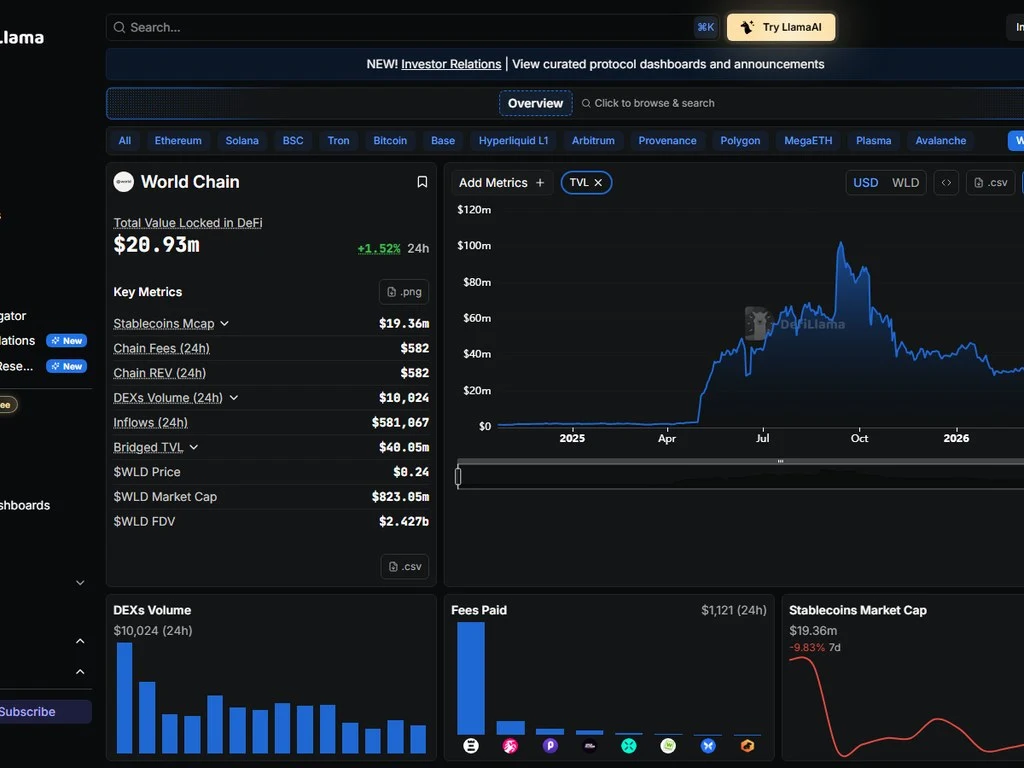
The dApp footprint on World Chain in 2026 looks a lot like the Optimism ecosystem with a couple of native-only additions. Most of the established Ethereum DeFi protocols redeployed to World Chain in the first six months after launch, drawn by the priority lane and the rapidly growing verified user base. A handful of native projects built specifically for the World Chain runtime have also emerged.
Morpho is one of the largest lending markets on World Chain by total value locked. Morpho's vault architecture is a natural fit, and a dedicated World Chain frontend with World ID-gated borrow limits launched in early 2025. Aave deployed its V3 markets to World Chain in February 2025, providing the standard set of money markets familiar to anyone who has used Aave on Optimism or Arbitrum.
Drachma is a World Chain-native stablecoin lending and yield protocol that uses World ID for identity-gated under-collateralised loans, an experiment that would be reckless on a pseudonymous chain but becomes tractable when you can prove the borrower is a unique human. Holdstation is a native mobile-first DEX and futures venue with deep liquidity in WLD pairs. Uniswap V3 and Velodrome also operate native deployments, providing the spot trading rails for the ecosystem.
Among the Mini Apps specifically, the most-used categories are savings (auto-investing biweekly grants), social tipping (sending small WLD amounts on chat-style interfaces), and prediction markets gated by humanity proofs. For deeper coverage of how DEX aggregation works across L2s, our guide on 1inch and DEX aggregators is worth bookmarking; many World Chain swap Mini Apps use the same routing logic under the hood.
Orbs, Operators, and the Verification Network
Behind the scenes of World Chain sits a logistics network unlike anything else in crypto. The Orb is a piece of custom hardware, manufactured in Germany, with a polished chrome exterior the size of a bowling ball. Inside it carries a multispectral camera, an NVIDIA Jetson AI module, and a tamper-evident secure element that holds the signing keys for verification attestations. There were roughly 2,000 Orbs in active operation by mid-2026, distributed across hundreds of cities.
Orbs are deployed by Operators, independent contractors who receive Orbs from the Worldcoin Foundation and run verification sites in shopping centres, pop-up booths, dedicated kiosks, and partner stores. Operators earn a fee in WLD per successful unique verification, paid by the protocol treasury. The model resembles the early Bitcoin mining era, except that the resource being produced is verified identity rather than block rewards. Operators are responsible for renting space, paying staff, and complying with local regulations.
Verification itself takes around 30 seconds. The user opens the World App, taps "Verify with Orb," is guided through a short positioning sequence, and the Orb takes the iris scan. The neural network runs locally, the iris code is hashed, the hash is compared against the global registry, and on success the user receives a World ID credential and an immediate grant of WLD as a welcome bonus. The whole flow is designed to be friendlier than airport security: lit warmly, voice-prompted, and short.
Privacy Architecture
Privacy is where World Chain has been most aggressively scrutinised, and where the architecture has changed the most over time. Early versions of the system stored encrypted iris images in a centralised database, which alarmed European regulators. The current design (deployed throughout 2024) does the opposite. The raw iris image is processed entirely on the Orb's secure module and then discarded. Only the hashed iris code leaves the device, and that hash is what the global registry compares.
For dApp-side interactions, the user proves humanity using zero-knowledge proofs, so even Tools for Humanity cannot link two World ID actions back to the same human without help from the user. This is conceptually similar to the privacy model behind cryptographic attestation systems in oracle networks: prove the property, not the underlying data.
Step-by-Step: How to Use World Chain Today
If you want to participate in World Chain in 2026, here is the full path from zero to actively using the network. The first few steps require physical access to an Orb, which is the gating factor that varies most by country.
Step 1: Download the World App
Install the World App from the iOS App Store or Google Play. Open it, create a wallet (the app generates a seed phrase that you back up immediately, the same way you would with any other self-custody wallet), and set a passcode. At this stage you already have a working wallet on World Chain, but you do not have a World ID yet, so you will not receive grants and will not get the priority lane.
Step 2: Find an Orb and Verify
The World App has a built-in Orb finder map. Filter by your country and city, and the app will show every active verification site near you. Some are permanent shopfronts, others are mobile pop-ups. Walk in, identify yourself to the Operator, and the verification takes around 30 seconds. After a successful scan, the World ID is credited to your wallet within minutes.
Step 3: Claim Your Initial and Recurring Grants
Once verified you can claim the initial welcome grant inside the World App with one tap. Subsequent grants drop automatically every 14 days. The app sends a push notification when a new grant becomes claimable. Each claim is signed by your wallet and lands as a normal on-chain transaction on World Chain, processed through PBH and gas-subsidised.
Step 4: Bridge Assets to World Chain
To use the DeFi ecosystem you will need additional liquidity beyond WLD grants. The official Superchain bridge supports ETH, USDC, and most major ERC-20 tokens, with deposits arriving on World Chain within a few minutes. Withdrawals back to Ethereum mainnet follow the standard seven-day optimistic challenge window, which is identical to Base and Optimism. Third-party fast bridges shorten the withdrawal time for a fee. Always double-check the bridge contract address; we cover the relevant security hygiene in our piece on address poisoning scams.
Step 5: Use Mini Apps and Native dApps
Open the Mini App grid in World App, pick whatever is interesting (a DEX, a lending Mini App, a prediction market, a social tipping app), and start transacting. Every signed transaction will use the World ID priority lane automatically. If you prefer to use desktop, you can also connect your World App to a desktop browser via WalletConnect and interact with the full dApp ecosystem the same way you would on Base or Arbitrum.
Step 6: Cash Out or Hold
WLD trades on most centralised exchanges (Binance, OKX, Bybit, Coinbase) and across the DEX layer. To realise grant income, swap WLD into USDC or ETH inside World App and bridge out to Ethereum mainnet (or directly to your CEX of choice on World Chain itself, if the exchange supports native deposits on the L2). For tax purposes, every grant is generally treated as ordinary income at the moment of receipt; rules vary by jurisdiction.
World Chain vs Base vs Linea
World Chain shares OP Stack DNA with Base, Mode, Zora, and OP Mainnet. Linea, by contrast, is a zkEVM operated by Consensys with its own circuit and prover architecture. Comparing these three is the most informative way to understand where World Chain sits in the L2 map. The differences are not really technical at the rollup core; they are differences in target user, incentive design, and identity philosophy.
The headline difference: Base optimises for the largest possible top-of-funnel by integrating with Coinbase. Linea optimises for zk-proof maturity and Consensys distribution. World Chain optimises for a smaller, identity-verified user base and is willing to accept friction in onboarding (you literally have to find a physical Orb) to make every wallet a known human. If you want to compare base-layer scaling economics more broadly, our piece on Ethereum gas pricing covers the L1 side that all three rollups inherit.
Regulatory Pushback: Country by Country
No L2 has had a more turbulent regulatory ride than World Chain, mostly because of the Orb. Authorities in multiple jurisdictions have raised concerns about biometric data collection, the consent of users (especially in lower-income countries during the early test phase), and the financial-incentive aspect of paying users WLD for an iris scan. Here is the rough status as of May 2026.
European Union: The Bavarian Data Protection Authority (BayLDA) launched a formal investigation in 2023 and reached a settlement in 2024 requiring Tools for Humanity to delete legacy iris data, provide stronger consent flows, and offer EU-friendly opt-out. The current Orb operation in the EU is permitted under that settlement. Spain: The Spanish Data Protection Agency (AEPD) issued a temporary three-month suspension of Worldcoin operations in March 2024, citing GDPR concerns. Operations resumed after revised consent processes were implemented. Tools for Humanity has remained operational in Spain since late 2024 under closer ongoing supervision.
Germany: Germany was the regulator that drove the original BayLDA investigation. Operations continue under the post-settlement framework. Kenya: The Kenyan government suspended Worldcoin verification in August 2023 citing financial inducement concerns and security risks. A parliamentary committee report in 2024 recommended a permanent regulatory framework before operations could resume. As of mid-2026 Worldcoin remains restricted in Kenya, although the project has appealed and discussions are ongoing.
South Korea: The Personal Information Protection Commission fined Tools for Humanity in early 2025 for inadequate consent procedures. Operations are paused. Hong Kong: The Privacy Commissioner ordered Worldcoin to cease operations in 2024 over biometric data concerns. Argentina: Initially friendly, although the government has since tightened oversight. United States: WLD is not available to US persons via the World App's grant mechanism (KYC-style gating), although the token trades on US-accessible markets through certain platforms.
This jurisdiction-by-jurisdiction patchwork is the single biggest practical limitation on World Chain's verified user growth. The chain itself is fully open and permissionless; anyone, anywhere can transact on it. But the Orb verification flow (and therefore access to PBH and grants) depends on local Orb availability. For users in restricted markets, the chain is usable but the unique identity layer is not, which dilutes the value proposition.
Risks and Honest Tradeoffs
World Chain is a fascinating experiment, but it carries a stack of risks that are easy to underestimate from a marketing page. Anyone considering verifying themselves at an Orb or holding WLD should weigh these explicitly.
- Sybil-resistant identity at chain level
- Recurring WLD grant for verified humans
- Priority blockspace and gas subsidy
- Mini App ecosystem with low friction onboarding
- Full EVM compatibility and Superchain interop
- ZK proof model protects unlinkability across dApps
- Biometric data collection requires deep trust
- Orb operation banned or paused in several countries
- Sequencer is still centralised at Tools for Humanity
- Heavy WLD unlock supply through 2027
- No US grant participation due to legal gating
- Dependence on Tools for Humanity governance decisions
On the biometric side, even the strongest privacy architecture cannot make hardware verification feel as harmless as a software signup. Users must physically present themselves and trust the device, the Operator, and the protocol. Cryptographic hashing is irreversible only as long as the underlying biometric extraction algorithm does not get reverse-engineered.
On centralisation, the World Chain sequencer remains operated by Tools for Humanity. While the OP Stack roadmap includes shared Superchain sequencing, in 2026 the practical reality is that TFH could censor or pause the chain unilaterally. The fault-proof system protects state correctness but not liveness. This is the same risk Base and OP Mainnet carry.
WLD unlock pressure is the third risk. The token's 15-year vesting schedule is generous, but a meaningful portion of investor and team allocations cliff-unlocked in 2024 and continue vesting linearly through 2027. Anyone holding WLD long-term should watch the unlock calendar. Our piece on tokenization and supply mechanics gives a frame for thinking about this.
Security Posture and Wallet Hygiene on World Chain
From a wallet-security standpoint, World Chain is no safer or more dangerous than any other EVM rollup. The same scams that work elsewhere work here: malicious token approvals, signature-phishing dApps, address poisoning, drained-clipboard malware, and fake support accounts in social channels. The fact that you are verified as a human does nothing to stop you from approving a malicious contract by mistake.
If anything, World Chain users face a slightly different attack surface, because their wallets are tied to a real-world identity. A user whose seed phrase is leaked cannot simply abandon the wallet and generate a new one, because their World ID is bound to the original key. World App provides recovery mechanisms (social recovery with trusted contacts, cloud-backed encrypted backups), but the loss of access is more painful than losing a normal pseudonymous wallet. Our practical guide on crypto wallet security applies the same way it does on every other chain; treat it as required reading before holding meaningful balances.
For interaction with new dApps, simulating the transaction before signing is essential. Most modern wallet UIs do this natively now, but doing a sanity check (what addresses am I approving, what amount, what spender) saves more money than any single piece of security advice. We cover the mechanism in detail in our piece on transaction simulation.
World Chain in the Broader Crypto Landscape
World Chain is best understood as one of three "identity-first" bets in crypto. The first is account abstraction, which solves account UX without changing identity primitives. The second is on-chain reputation graphs, which build identity layers on top of arbitrary wallets. The third is proof of personhood, which inserts a binary "human or not" check at the credential layer. World Chain is the most aggressive expression of the third bet.
If proof of personhood becomes a standard primitive, World Chain is sitting on a strong early position. If it does not, the chain will still function as a decent OP Stack L2 with a loyal community of grant-receiving users. For traders, the most actionable framing is to treat WLD's price as a function of three independent variables: rate of new verified humans, depth of the dApp ecosystem, and macro pace of WLD unlocks. Cross-referencing this against market analysis frameworks can sharpen entry-and-exit thinking.
Video: World Chain and Worldcoin in Practice
Visual walkthrough of World Chain, the Orb verification, and the World App Mini App experience.
Frequently Asked Questions
Q What is World Chain in simple terms?
World Chain is an Ethereum Layer 2 rollup built by Tools for Humanity on the OP Stack. It launched in October 2024 and is designed around verified humans. Users who prove their humanity through an iris scan at a Worldcoin Orb receive priority transaction inclusion and gas subsidy on the network, plus a recurring WLD token grant every 14 days.
Q How is World Chain different from Base or Optimism?
Technically, World Chain, Base, and Optimism are all OP Stack rollups and members of the Superchain. The difference is the identity layer. World Chain enforces a credential called World ID at the sequencer level, granting verified humans priority blockspace and partial gas subsidy. Base and Optimism treat all wallets equally regardless of who owns them.
Q Do I need to scan my iris to use World Chain?
No. World Chain is permissionless. Any wallet can submit transactions, interact with dApps, and hold WLD. However, you only receive Priority Blockspace for Humans, the gas subsidy, and the biweekly WLD grant if you have a World ID, which currently requires an iris scan at an Orb verification site.
Q What is Priority Blockspace for Humans?
Priority Blockspace for Humans (PBH) is the World Chain sequencer rule that reserves part of every block for transactions signed by World ID holders. Reserved transactions are included first, are protected from being out-bid by bot traffic during congestion, and receive a partial base-fee refund funded by the Worldcoin Foundation treasury. PBH is enforced at the protocol level, not at the application level.
Q Is my iris image stored anywhere?
Under the current verification flow, no. The Orb processes the iris image locally on its secure module, generates a hashed iris code, and discards the raw image. Only the hashed iris code leaves the device, and that hash is used to detect duplicate verifications. Earlier versions of the system did store encrypted images; those have since been deleted following European regulator settlements.
Q How much WLD do verified humans receive?
As of mid-2026 the standard grant is roughly 3 WLD every 14 days, paid automatically into the user's World App wallet. There is also an initial welcome grant at the moment of verification, and additional supplementary grants funded by ecosystem partners for specific actions like using a particular Mini App. The exact figure changes over time and is adjusted by the Worldcoin Foundation based on price and supply targets.
Q Is WLD available in the United States?
The WLD grant program is not available to US persons through the World App. The token itself trades on US-accessible markets through certain platforms and instruments, but Orb verification with grant participation is geo-restricted in the United States. This is a legal compliance decision by Tools for Humanity, not a technical limitation.
Q What is the maximum supply of WLD?
WLD has a hard cap of 10 billion units. Around 75 percent of supply is allocated to the Worldcoin community (grants, ecosystem, foundation operations), 13.5 percent to early investors, 9.8 percent to Tools for Humanity team and contributors, and 1.7 percent reserved for future operational use. Vesting extends 15 years from the July 2023 genesis.
Q Can I bridge to World Chain from Ethereum?
Yes. The official Superchain bridge supports ETH, USDC, and most major ERC-20 tokens from Ethereum mainnet. Deposits arrive within minutes. Withdrawals back to Ethereum follow the standard 7-day optimistic challenge window, identical to Base and OP Mainnet. Third-party fast bridges shorten the withdrawal time for a small fee.
Q Which countries restrict Worldcoin operations?
As of May 2026, Kenya, Hong Kong, and South Korea have paused or restricted Worldcoin Orb verification. Spain temporarily suspended operations in 2024 but later resumed under revised consent flows. Germany and the wider EU operate under a settlement with the Bavarian Data Protection Authority. The United States restricts the grant program (but not chain access).
Q What is a Mini App on World App?
A Mini App is an application embedded inside the World App mobile wallet. Mini Apps are written in HTML and JavaScript using the World App SDK, install instantly without an app store review, and inherit the user's wallet and World ID identity automatically. The architecture is similar to WeChat's mini-program system in China and includes DeFi, gaming, prediction markets, and social tipping apps.
Q Is World Chain decentralized?
Partially. World Chain inherits Ethereum security through the OP Stack rollup model, with fault proofs and L1 data availability. However, the sequencer is currently operated by Tools for Humanity, meaning TFH can censor or pause the chain. Decentralization of the sequencer is on the roadmap, aligned with the broader Superchain shared sequencing effort.
Conclusion: Should You Bother With World Chain?
World Chain is one of the more philosophically loaded experiments in crypto. It bets that proof of personhood, built into the gas market itself, is a foundational primitive for the next decade of on-chain applications. If that bet is right, the chain has a structural moat no rival rollup can replicate without building its own biometric registry, which most teams will not do.
If you are looking purely for a low-fee EVM L2 to swap on, Base and Arbitrum offer comparable experiences without the friction of finding an Orb and being scanned. If you care about identity, sybil resistance, gas subsidies, and the recurring WLD grant, World Chain is the only network in 2026 that delivers all four in a single integrated package. The right answer depends on which side of the proof-of-personhood thesis you fall on.
For traders, WLD is a position trade on the success of that thesis, calibrated against a known unlock schedule. For builders, World Chain is a place where you can ship Mini Apps to millions of verified humans without building your own identity layer. For everyday users in countries where the Orb operates, claiming the biweekly grant is one of the few "free crypto" mechanisms left that does not feel like a points-farming charade. As always, before you commit any real capital or biometric data, do your own due diligence and read the official documentation at world.org. The Layer 2 race is far from over, and World Chain is one of the most distinctive horses in it.